The Sternberg host desecration trial of 1492 was by no means the first incident in Mecklenburg that slandered Jews. Its historical significance and its supra-regional notoriety, however, far exceeds that of the preceding pogroms. It became so well known that the town of Sternberg in historical research today is still primarily associated with the death by fire and the expulsion of the Jews and their nearly 200-year absence from Mecklenburg, but only rarely with the Jewish community that later existed here in the modern era. Few anti-Jewish incidents in Mecklenburg were as successful in defaming and branding the Jews as a treacherous, malicious, and obstinate minority as the Sternberg host desecration managed to do over centuries.
The legend was published again and again, with authors frequently copying from their predecessors and not infrequently adding further alleged facts. The actual event is therefore difficult to relate in a definitive and all-encompassing form:
The central figure of the tradition was the Sternberg priest Peter Daene. He kept a drunken cook and concubine. Daene, always short of cash, borrowed money from a wealthy Jew of the town named Eleasar and pledged to him in return a cooking pot belonging to his cook, called a Grapen. She demanded it back loudly, however. Eleasar offered Daene a way out of his predicament: he would get the Grapen back if Daene in return procured him two consecrated hosts. Eleasar was planning his daughter's wedding, and the desecration of these hosts was to be the highlight of the celebration. Daene did as he was told and received his Grapen. Eleasar and the Jewish wedding party then desecrated the hosts by piercing them with awls and slashing them with knives, whereupon the hosts bled.
Since the Jews became uneasy about their deed, Eleasar handed the desecrated hosts to his wife with the order to burn them. But she could not put them into the glowing oven. She then tried to throw them into the mill stream by the mill gate, but they leapt out of the water back into her apron, or else she sank with her feet into a large boulder and was unable to throw them into the water at all. After she could not bury them either, she brought the hosts on the Tuesday before Bartholomew's Day in a candleholder, a hollow wooden lantern, to Daene. He tried to return the hosts to the church but was equally unable. Since an unknown force made it impossible for him to leave the Fuerstenhof with the hosts in his hands, he buried them there on the spot.
From then on, Daene was plagued by nightmares and visions. Several times an angel of God appeared to him in his sleep and prompted him to ease his conscience with other priests and eventually to speak to the Schwerin cathedral provost. The news ultimately reached the bishop of the land, and so the matter had to be brought before Dukes Magnus II and Balthasar. The inevitable investigation of the affair led to the arrest of all the Jews and the priest. After Daene had revealed the location of the hosts and they had been dug up, it was found that they had been pierced and the blood of Christ still adhered to them. The hosts were brought to the Marienkirche and placed on the altar there.
Through his behavior, suspicion fell on Daene, who promptly accused the Jews of the deed. The judicial torture of the Jews on 23 October 1492 naturally produced a comprehensive confession, the Urgicht, which moreover brought forth further monstrosities: the Jews had previously procured and desecrated further hosts in Teterow and Penzlin and had even induced a monk to convert to Judaism. Both the Penzlin monk and many Jews escaped their punishment by flight. Eleasar too evaded pursuit, for he had already fled after the discovery and was never seen again.
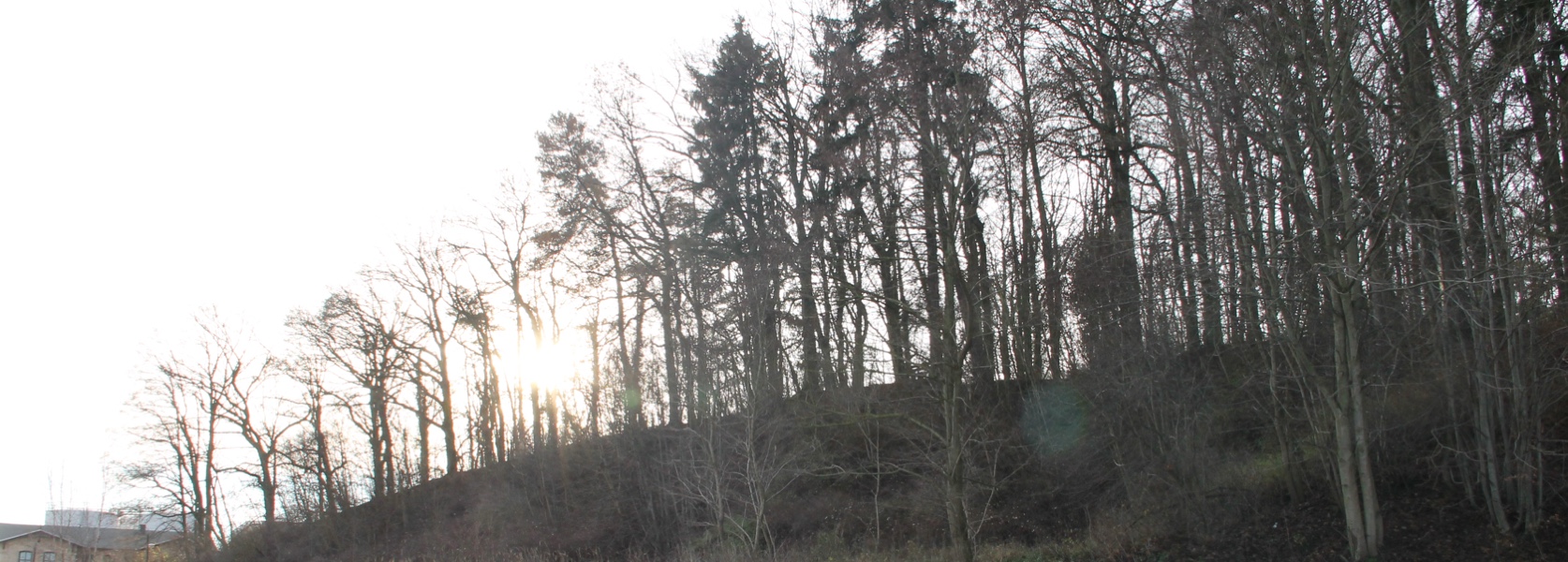
The other Jews fared badly. The condemned, a total of 25 men and two women, were finally led on 24 October 1492, in the presence of the territorial princes, to a hill outside the town to receive their just punishment. With the stake in sight, Duke Magnus once more appealed to a Jew named Aaron and offered him baptism as a way out. But both he and all his fellow believers walked with heads held high, singing their traditional psalms, into the death by fire. The hill was henceforth called only Judenberg. Eleasar's house at the corner of Pastiner Strasse opposite the churchyard was torn down as further punishment and remained derelict for a long time thereafter. Priest Peter Daene did not escape his just punishment either. After his confession, he had been taken to Rostock and was, on the Friday after Gregorii 1493, after being shamefully driven through the town and pinched with various painful instruments, likewise consigned to the flames at the execution site on the Koeppelberg outside Rostock.
Even though all remaining Jews of Mecklenburg were declared innocent after the investigation, the dukes confiscated all their possessions and permanently expelled them from the land of Mecklenburg. Enraged in turn by the events, rabbis outside Mecklenburg thenceforth placed a ban on any Jew who wished to settle in Mecklenburg.
The expulsion of the Jews from Mecklenburg served shortly after the deed also as a template for a further pogrom. Duke Magnus' wife, Sophie of Pomerania, was the sister of Duke Bogislaw X of Pomerania. That same year, he forced all Jews in Pomerania, under the pretext of the Sternberg accusation, to accept baptism, ultimately expelled them after their refusal from the land, and confiscated their property, although they had previously given not the slightest cause for complaint.
While the Sternberg deed had thus become an eternal trauma for all Jews, it developed in contrast for the ecclesiastical and secular rulers, the town, and the region into a significant economic factor. After the desecration trial had received an unprecedented media presence through the just-emerging printing press and the consequently numerous pamphlets published about it, the most important consequence of the incident was the ensuing pilgrimage tourism, which brought money into the coffers of the duke, the bishops, and the town alike. For everyone wanted to see the blood-stained hosts. The Holy Blood Chapel and the Corpus Christi Chapel were built, an Augustinian monastery was founded, and henceforth truly unbelievable miracles occurred: the blind could see, the deaf could hear, the lame could walk, the drowned were brought back to life, the sick of every kind were suddenly healed... and a miraculous spring even appeared. Thus Sternberg gained renown as a pilgrimage site throughout Europe. For over 30 years the spectacle continued. Only the Reformation was finally able to put an end to it.
It would take many more centuries until the alleged Sternberg host desecration and the subsequent trial were described as what it was, according to the evidence, sources, and facts still available today: a judicial murder driven by superstition and medieval prejudices and fueled by pure greed.
To this day, one can still marvel at the excesses of this madness in the form of "evidence" at and inside the Sternberg market church: the wooden table on which the hosts were allegedly tortured, and a stone with footprints into which Eleasar's wife supposedly sank. A memorial in the Holy Blood Chapel within the church today commemorates this incident, which was to shape the history of the town of Sternberg forever.
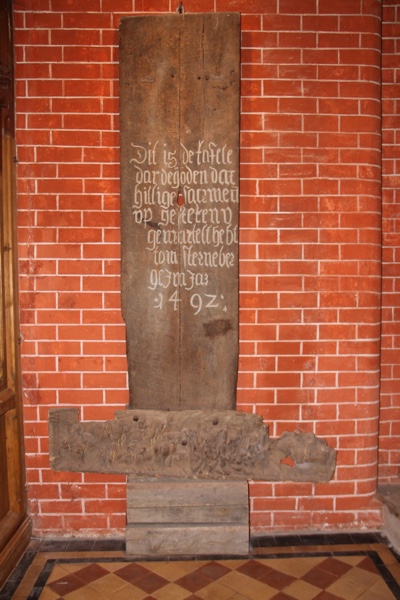
The oaken table from Eleasar's garden pavilion, Sternberg market church (© Juergen Gramenz).
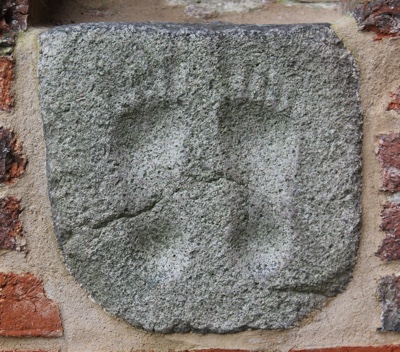
The alleged footprints of Eleasar's wife, outer wall of the Sternberg market church (© Juergen Gramenz).