O. G. Tychsen and His Points of Contact with the Jews in Mecklenburg-Strelitz
The following account attempts, by drawing on the identifiable contacts of the scholar Oluf Gerhard Tychsen (1734-1815), to supplement and specify the development of Jews and their community in the 18th century in the Duchy of Mecklenburg-Strelitz, particularly for the period of the 18th century. Let us first turn to the Orientalist himself, the scholar of Semitic languages and literature as well as knowledgeable numismatist.
O. G. Tychsen was born on 14 December 1734 in Tondern in what was then Danish North Schleswig, into the impoverished family of the tailor and (probable) former Danish non-commissioned officer Juergen Tychsen and his wife Hanna Gerhardsen. After his school years and youth in Tondern, he obtained, through a scholarship awarded by a wealthy benefactor to the gifted and inquisitive boy, access to a higher school only in 1752. He attended the Gymnasium in Altona for three years and then began university studies in theology at Jena in 1755 and a year later in Halle. From 1757 to 1759, he worked as a teacher and supervisor at the orphanage of the Francke Foundations in Halle. From his school years through his student years in Halle, he acquired, partly from Jewish teachers, outstanding knowledge of the ancient Jewish languages, in Hebrew and in Yiddish. He came into contact in Halle with the scholar Callenberg and prepared himself at the latter's "Mission Institutes for the Conversion of Jews and Mohammedans" for work as a missionary for conversion to Christianity. Indeed, Tychsen undertook two journeys for Jewish missionizing in 1759/1760 to Lower Saxony, Denmark, and Mecklenburg, but without any success. The attempts at "proselytizing" occupied him throughout his life, however. "Tychsen always remained of the opinion that it was in the best interest of every person to become a Lutheran." [1]
Upon his return, he endeavored to continue his education and studies at the [Page 2] Ducal Mecklenburg Friedrich University in Buetzow. He was initially employed as a "magister legens" (salaried lecturer) at the university and soon thereafter, in 1761, obtained the master's degree (Mag. art.) at the same institution. From 1763 to 1789, a total of 16 years, he remained Professor of Oriental Languages at Buetzow University. As early as 1766, he was appointed rector for one year, an office he held several more times. From 1770, he served as librarian of the Academic Library of Buetzow, which he built up until it could be opened in 1772. In 1775, he received the title "Ducal Court Councillor." With the merger of the universities of Rostock and Buetzow, he ultimately worked from 1789 until his death in 1815, another 26 years, as professor in the same field in Rostock, as well as in other capacities. He simultaneously served as chief librarian, custodian of the newly founded natural history cabinet (until 1799), and director of the coin cabinet.
Even in old age, as a special honor, he was entrusted with the duties of Vice-Chancellor of the university within the framework of academic self-governance. He received extensive scholarly recognition and was between 1791 and 1815 a member or honorary member of scientific academies and societies in several countries. The Orientalist O. G. Tychsen has an impressive number of publications on questions of Jewish religious and other literature as well as on contacts with Jews of his time to his credit. Most of these works contain relatively many texts in Hebrew or Yiddish and, despite containing translated passages, are difficult to read for anyone unfamiliar with these languages. This applies in part also to his collected essays in the "Buetzowische Nebenstunden"[2], which appeared between 1766 and 1769, with which he actually wanted to reach a broader Jewish and especially non-Jewish audience. Although many authors rightly criticize Tychsen's "Nebenstunden" for their content that often denigrates Jews, we can assume that the historical facts contained therein do correspond to reality. We have [Page 3] therefore highlighted and connected the facts pertaining to the territory of the Duchy of Mecklenburg-Strelitz. From the time of the initial settlement of Jews in the Mecklenburg region between the beginning of the 13th and the end of the 15th century, very little is known. Tychsen remarks on this that "the merely tolerated people had probably never been graced with significant privileges and prerogatives in Mecklenburg, so that anything about them in the Archivis Ducabilus [= in the Ducal Archives] could be deemed worth preserving for posterity"[3]. The following roughly 200 years encompass a period of expulsion of Jews from all parts of Mecklenburg. Only at the transition from the 17th to the 18th century did a gradual resettlement begin in the two Mecklenburg duchies by individual Jewish persons and families. The editors of the website of the "Project Jews in Mecklenburg" cite -- with reference to Tychsen -- the year 1698 for Mecklenburg-Strelitz, but also consider the date 1703/1704 possible. Tychsen presents the facts as follows:
"Around the year 1698, the then Duke of Strelitz [and] his consort also had a court Jew, Rabbi Iakof from Frankfurt an der Oder, ... in their service. [Later] the servant of the above-mentioned Iakof, named Wolf, became the court Jew of Duke Adolf III. Through this Wolf, the Jewish community in Strelitz was actually founded." [4]
[Page 4] After this, we find no remarks by Tychsen about the Jews in Strelitz for a period of roughly 60 years. He mostly returns to Jews from Schwerin. This can certainly be explained by the fact that his actual employer was the Duke of Mecklenburg-Schwerin, from whose territory he also wanted to report most of the news. Only in the "Nebenstunden" of 1768 do we find the following entry: "A letter to me in Hebrew and German rhymes from Strelitz, 16 April 1766, by Simon Elkan, written there."
The poem thus transmitted to Tychsen is a praise of the scholar, whose occasion or cause we do not know. Tychsen, who was very receptive to recognition of all kinds, surely had this text printed with pleasure. We quote this poem:
"I am not called Cicero in poetry, nor like Guenther and Neumann,
For such artists I must flee, yet I write as best I can.
What? Should I boast of praising Your Noble skill?
Or embellish it in verse and clearly show the world?
If the heavens were parchment, and all fir trees were quills,
And as many hands as there are stars, and the sea should turn to ink,
To depict Your perfection -- my brushes paint not so fine.
Among all wise images, I find no face so illuminating.
Oh! If only I were a mint master, or a skilled medallist,
I would surely take the honor and stamp in fine Dutch coin
Your Noble image like Antoninus, the pious Roman Emperor,
[Page 5] In philanthropy You resemble Venus,
In learning a righteous sage.
Never has one heard or seen a professor so great
To associate so much with Israelites, nor goodness better and greater like Aurelius,
Affable like Severus, south and north display His perfection,
In experience more than Corelus, east and west know His erudition."
[5]
Only in the following part of his "Nebenstunden" do we find, under the title "Continuation of the recent history of the Jews in Mecklenburg," further facts about Jewish development in Strelitz. These are some figures on the number of protected Jews in the two Mecklenburg duchies from the year 1767.[6] Tychsen gives the following numbers for that year for privileged protected Jews:
| In Schwerin: | 43 protected Jews |
| In other places in the duchy: | 162 " |
| In Strelitz: | 131 " |
| Total: | 336 " |
These figures show that in Strelitz alone approximately 40% of all protected Jews residing in the two Mecklenburg duchies lived. If we take another figure that Tychsen cites -- that a Jewish family with possible servants comprised on average six persons -- and if we can further assume that the majority of people were families, then in 1767 approximately 700 Jewish persons may have lived in Strelitz alone. A considerable settlement density that was probably not matched in many [Page 6] places in the German lands! This extensive settlement is attributable, among other things, to the more liberal attitude toward Jews in Mecklenburg-Strelitz compared to Mecklenburg-Schwerin, and of course to the specific economic and financial interest of the Strelitz dukes following the great city fire of Strelitz in 1712.
In the same issue of the "Nebenstunden," Tychsen presents, in the context of references to recently published Jewish literature, a book by Rabbi Jehuda Levi Horwitz (Jehuda Lebh), published under the title "Resurrection of the Dead" in Hebrew in Amsterdam in 1767. According to Tychsen, this was a Jewish physician who had come from Mecklenburg-Strelitz, "had given up his business in Strelitz and on account of his Jewish learning [in Birnbaum/Miedzychodz in Greater Poland] had become a Polish Raf [= a Yiddish word for rabbi] half a year ago." Various Jews would attack the author of this book, who could not actually be counted among Jewish Orthodoxy, with the argument that "no one should read his book, because it contained heretical things, and it was altogether foolishness to write such things, since such matters stood much more beautifully and clearly in the Bible"[7]. Tychsen apparently held this Jehuda Leb in very high regard. He translated the aforementioned work "The Resurrection of the Dead," which Jehuda Lebh had already written in 1765, into German and published this translation in 1766 in Buetzow. The author shows himself therein extraordinarily modest. His closing words read: "... I, the least among the scholars, Jehuda Lebh the Levite from Strelitz." And at the end of his own preface it says: "Thus wrote the little Jehuda Lebh, of the tribe of Levi. -- Strelitz, on Wednesday, the 5th of Ab, [Page 7] 525 according to the lesser count, that is, the 23rd of July 1765."[8] Tychsen prefaced the work with a "Preliminary Report of the Translator," in which he writes about the author: "[The author] is called Jehuda Lebh, otherwise known by his common name in everyday life as Levi Hirsch Levi, and now holds with great renown the office among the Jews so highly esteemed of Parnas or Elder in the numerous Jewish community of Strelitz. Among his ancestors -- both those who trace their lineage from the tribe of Levi and therefore bear the surname Levi, and among his still living relatives in and outside Germany -- he counts the most famous scholars, of whom I content myself for now with naming the Marcus Moses from Pressburg, who was publicly promoted here[9] to Doctor of Medicine, and who is married to his wife's sister -- [both] daughters of the famous Jewish elder Meschulles Pheibes residing in Strelitz." [10]
Tychsen also examines, using the example of Strelitz, the question of how a Jew should swear an oath before a Christian. He describes the situation:
[Page 8] "When the Jews have obtained from the Christian authorities the freedom to swear oaths on a printed Bible [meaning a Bible in Hebrew] without other ceremonies, they have fulfilled their wishes. That I write from experience, the following must attest: In Strelitz, the most praiseworthy custom is that the Jews swear on a kosher-written book of the Law, adorned with the talles[11] and prayer straps, in the courtroom, and to that end must always bring the Torah from their school. (This is better than keeping one in the courtroom at all times, since the Jews declare it unfit because it cannot stand in their holy ark.) The entire Jewish community there has had letters written to me repeatedly, asking that I, for a hoped-for handsome reward, endeavor through my representations to the councillors there to bring about the abolition of this custom so fatal to them, by which their holy book of the Law is defiled, and that they might obtain permission henceforth to swear oaths on a printed Bible, as is customary in Berlin and other places. Moreover, they even compel Jews who are merely giving testimony to swear their depositions on a written Torah, on the grounds that a true oath is a commandment, without considering that this would then yield 614 commandments and prohibitions, whereas the Jews have had only 613 until now. Since my answer accorded with my above-stated conviction [Tychsen advocated for oath-taking on the Torah], this negotiation ended rather heatedly, and the eldest Parnas Loew wrote to me, among other things: even though I live in Mecklenburg, my quill cannot have been borne by a Mecklenburg goose, nor can it have been cut by a Mecklenburger."
Tychsen argues that if oath-taking on a printed Bible were generally permitted, it could open the door to false oath-taking, since a non-Jew -- who cannot recognize a printed Hebrew Bible as such -- could easily be deceived and cheated. By contrast, a handwritten Torah is easily [Page 9] recognizable as such even by non-Jews.[12] This would also largely eliminate the temptation to swear falsely and to take a so-called "ox oath" (through various wordplay pretending to swear on the Law). He further says that even in an oath among Jews themselves, one must guard against deception, for problems can arise in such situations as well. Thus Tychsen writes:
"The Jews do this among themselves, of which I will cite merely the following passage from a letter written to me on 26 January 1767 by a Jewish scholar from Strelitz: 'The Strelitz Jewish community has elected R. Sanvil from Brandenburg as their rabbi, although R. Lebh and R. Schmuel were very much opposed. For the former thought of becoming Raf himself. This led to fierce disputes, and pasquils [= public postings, lampoons intended to slander or dishonor a person] were written against the new Raf and sent to Berlin, where he was at the time. The night before the Raf's inaugural sermon, pasquils were again found, in which he was described as a follower of Shabs Zwi (which is the greatest insult), and because R. Lebh was suspected, he swore before the entire community of his own accord ... (whether he too took an ox oath?), that he knew nothing of it.'" [13]
The "Buetzowische Nebenstunden" were received very differently by Jews. Tychsen himself writes as early as Part 2 in 1766 that many Jewish readers had warned other Jews about Tychsen because of certain statements. In Strelitz, such warnings seem to have had little effect, for Tychsen notes that "many of their sensible [Page 10] scholars in Poland, Pomerania, Holland, East Frisia, Strelitz, and elsewhere ... continued their previous learned correspondence"[14]. This surely also had something to do with the relatively liberal social and political conditions in the Strelitz area. With a view to somewhat differing developments in the two Mecklenburg duchies, one can emphasize: "In the smaller Mecklenburg-Strelitz, developments occurred that were atypical for the end of the 18th century. There, Jews owned breweries, tobacco factories, or mills ..."[15] It was also a non-Jewish personality from Strelitz, the Strelitz judicial councillor and later mayor of Neubrandenburg, Friedrich Andreas Mueller, who in 1802 anonymously published a work in Berlin advocating the equality of Jews in the state.[16] Without going into further detail, the observation remains that despite individual advances, it was still a long road to changing the legal status of Jewish citizens. For all the contradictions in his thinking and actions, O. G. Tychsen deserves a place in this process as a "mediator between Jews and Christians."
Notes and Sources
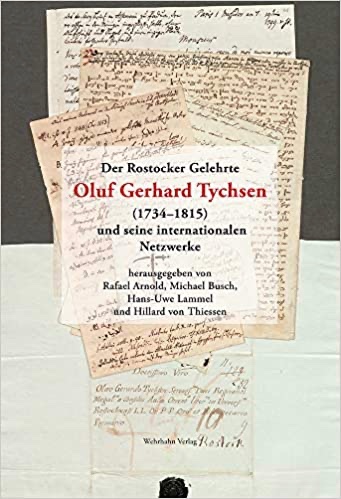
- [1] Heinsohn, Ulf/Jennrich, Jacha: Oluf Gerhard Tychsen – Hebraist und Mittler zwischen Juden und Christen. – 2015.
- [2] Tychsen, O. G.: Bützowische Nebenstunden, verschiedene zur morgenländischen Gelehrsamkeit gehörigen Sachen gewidmet. – In sechs Teilen. – 1. Teil: Bützow, 1766. – 2. Teil: ebd., 1766. – 3. Teil: ebd., 1768. – 4. Teil: ebd., 1768. – 5. Teil: ebd., 1769. – 6. Teil: ebd., 1769. – Online-Veröffentlichung der Universitätsbibliothek Rostock.
- [3] Nebenstunden, T. 2, 1766, S. 11
- [4] Nebenstunden, T. 3, 1768, S. 5. – Eigentlich handelte es sich um drei Hofjuden: um die beiden Frankfurter Bankiers Jakof Isaak (= Rabbi Iakof) und Simon Moyses. Dazu kam über die Gattin des Herzogs Adolph Friedrich ein Hofjude Alexander aus Sondershausen. Nachdem diese drei 1704 das Wohnrecht erhielten und auch ihre Familien und ihre drei Knechte nachholen konnten, bildeten sie die erste jüdische Gemeinschaft zu Beginn des 18. Jahrhunderts in Strelitz. Im Online-Projekt „Juden in Mecklenburg“ wird dazu angenommen, dass diese Gruppe auch schon über einen jüdischen Lehrer verfügt haben könnte.
- [5] Nebenstunden, T. 4, 1768, S. 46-48. – Dazu schreibt Tychsen in einer Fußnote: „Die Absicht dieses bekannt gemachten Briefes soll in einem der folgenden Teile entdecket werden. Jetzt ist es zu frühe.“ – Tychsen kommt aber nicht wieder darauf zurück. Bei dem Juden Elkan handelt es sich um Rabbi Simon Elkan, der „ein bekannter und trefflicher Gesetzesschreiber in Strelitz“ (nach Tychsen 1766) war und der mit dem Münz-sammler Tychsen über die Numismatik in Verbindung gestanden hat. – Simon Elkan hat offensichtlich noch weitere Gedichte verfasst, so ein Huldigungsgedicht zum Geburtstag der Herzogin Dorothea Sophie am 04. 12. 1747.
- [6] Nebenstunden, T. 5: 1769, S. 13.
- [7] Nebenstunden, T. 5: 1769, S. 53-55. – Jehuda Lebh gehört zu den ach jüdischen Studenten, die an der Bützower Universität unter der Förderung durch Tychsen ihr Medizinstudium abschließen konnten.
- [8] Der Text des Titelblattes dieser deutschen Ausgabe lautet: „Die Auferstehung der Toten aus dem Gesetz Mosis – bewiesen von R. Jehuda Lebh, Deputierter und Judenältester zu Alt-Strelitz im Herzogtum Mecklenburg-Strelitz und auf Verlangen aus der hebräischen Handschrift ins Deutsche übersetzt. – Bützow, 1766.“ – Zitate hier auf S. 46 u. … Zu ergänzen wäre aus dem „Projekt Juden in Mecklenburg“: Jehuda Lebh war spätestens Rabbiner und Vorsteher der jüdischen Gemeinde in Strelitz. 1780 wurde er als Rabbiner nach Stockholm berufen, er wurde Oberrabbiner von Stockholm und auf königliche Order auch gleichzeitig der Ober-rabbiner des Königreichs Schweden.
- [9] Der Formulierung „hier“ ist zu entnehmen, dass auch der genannte Marcus Moses sein Doktorstudium an der Herzoglich-Mecklenburgischen Friedrichs-Universität in Bützow abgelegt hat. Seine Medizin-Promotion in Bützow ist maßgeblich von Tychsen unterstützt worden, sie war überhaupt die erste Promotion eines Juden an der Bützower Universität. Das Thema der in lateinischer Sprache verfassten Dissertation lautet in der deutschen Übersetzung: “Das von Ebraeo beschriebene hebräisch-samaritanische Pentateuch-Modell“. Letztlich geht es darin um die Frage, welche der jüdischen Gesetze, die in den funf Büchern Moses enthalten sind, stammen direkt von Moses bzw. welche sind wesentlich älter oder auch jünger, Im Nachlass von Tychsen befindet sich eine ganze Reihe von Exemplaren aus dem Briefwechsel zwischen Tychsen und Marcus Moses, darunter dessen offensichtliches Dankschreiben an Tychsen (in Hebräisch) nach seiner Disputation 1766.
- [10] Tychsen, O. G.: In seinem Vorwort der Schrift „Die Auferstehung der Toten von Jehuda Lebh, S. 3 f. - Tychsen benutzt hier den Begriff „Parnas“ im Sinne des „Gemeindeältesten“, meint aber wohl die Funktion des Vorstehers, wahrscheinlich nahm Jehuda Lebh auch beide Aufgaben wahr. Zu ergänzen wäre aus dem „Projekt Juden in Mecklenburg“: Um 1763 war Jehuda Lebh Rabbiner und Vorsteher der jüdischen Gemeinde in Alt-Strelitz und wurde 1780 zunächst Rabbiner, dann Oberrabbiner in Stockholm/ Schweden und damit gleichzeitig der Oberrabbiner für das schwedische Königreich.
- [11] Talles oder Tallit ist ein mit 613 Fransen versehener ritueller Gebetsmantel.
- [12] Nebenstunden, T. 5: 1769, S. 82 f.
- [13] Nebenstunden, T. 6: 1769, S. 85. Hierzu eine kurze Erläuterung: Die zumeist nur als Kürzel geschriebene Bezeichnung „R.“ steht für Lehrer, besonders für einen religiösen Lehrer bzw. Meister, also für einem im jüdischen Glauben und Recht gebildeten und anerkannten Menschen; die Auflösung des Kürzels führt zum Begriff des „Rabbi“ bzw. des „Reb“. – Der Begriff „Rabbiner“ bezieht sich auf einen Geistlichen, der von einer jüdischen Gemeinde als ihr religiöser Führer gewählt wird. Die Begriffe „Rabbiner“ und „Rabbi“ sind nicht deckungsgleich, obwohl ein Rabbiner immer auch eine religiös gelehrte Person ist. – „Raf“ ist ein Synonym für „Rabbiner“. - „Schabs Zwi“ bezieht sich auf den Sabbat, den Ruhetag, in diesem Fall auf einen Menschen, der gegen die Sabbatregeln verstößt.
- [14] Angeführt bei: Małgorzata Anna Maksymiak: Korrespondenz – Macht – Verflechtung. – Oluf Gerhard Tychsen und seine Sammlung von jiddischen und hebräischen Privatbriefen. – In: Rostocker Studien zur Universitäts-geschichte, Bd. 28. – 2014, S. 75
- [15] Michael Busch: Oluf Gerhard Tychsen und die Erweiterung der Staatsbürgerrechte der Juden von 1813 in Mecklenburg. – In: Der Rostocker Gelehrte Oluf Gerhard Tychsen (1734-1815) und seine internationalen Netzwerke. – 2019, S. 201.
- [16] Anonymus: Über Aufnahme und Concessionierung der fremden und einheimischen Juden, in rechtlicher und staatswirtschaftlicher Hinsicht, mit besonderer Beziehung auf Mecklenburg-Strelitz. – Berlin 1802. – Zitate daraus angeführt bei Busch, Michael, a. a. O., S. 105 ff.