On the Connections of Moses Mendelssohn and His Family in the 18th Century to the Duchies of Mecklenburg-Schwerin and Mecklenburg-Strelitz
The Jewish scholar Moses Mendelssohn (also known as Moses ben Menehem-Mendel or Moses Dessau), German philosopher and outstanding representative of the Enlightenment (1729 -- 1786), spent most of his life in Berlin. He maintained connections to both duchies of Mecklenburg, particularly to the residential city of Neu-Strelitz. We owe it to the author Siegfried Silberstein that we can provide some information about these connections in the final decades of the 18th century. Through research in the "Strelitzer Hauptarchiv" (Strelitz Main Archive), Silberstein was able to compile various documents with revealing facts, although partly unorganized and containing some incorrect dates. It is worthwhile, however, to prepare the available materials for local historical research. Silberstein was a prominent figure of Judaism in Mecklenburg-Schwerin for nearly two and a half decades. He was born on 25 January 1866 in Gross Langiewnik / Lagiewniki Wielkie in Silesia. After schooling, studies, and his ordination as a rabbi in 1893, he took up the rabbinate in the Jewish community of Elbing/Elblag, where he served for 17 years. In 1910, he was appointed State Rabbi of Mecklenburg-Schwerin with his official seat in Schwerin. After the rabbinate was relocated, he lived from 1925 until his death in Rostock. He was a member of the "Association of Liberal Rabbis of Germany." In this capacity and throughout his entire career, he strove for the cohesion of Judaism and particularly for reconciliation between liberal Judaism and the Orthodox Jewish influences that had been brought about by a relatively strong Jewish immigration from Eastern European states to Germany. Silberstein was interested in history, with his main focus on the philosopher Moses Mendelssohn and the history of Judaism in Mecklenburg.[1] With the rise of National Socialism, anti-Jewish measures were also implemented here in Mecklenburg. As early as 1933, the State Rabbi was stripped of his [Page 2] status as a state official. Since the Jewish state community was financially unable to pay the rabbi a salary, Silberstein was forced to retire in March 1934. In 1935, the National Socialists removed him from the membership register of the "Association for Mecklenburg History and Antiquities" because he was Jewish. He died in Rostock on 8 August of the same year.
In this essay, we follow a remark by David Friedlaender, a representative of the generation of Jewish enlighteners following Mendelssohn, who said of Mendelssohn: "What of our philosopher shone outwardly in the great world; what he accomplished as a German writer, as a co-shaper of literature, as the creator of true criticism, does not belong to our subject."[2] We limit ourselves to a few facts of his life and the identifiable contacts with Mecklenburg.
Moses Mendelssohn and His Family and the Contacts to Strelitz
Let us turn to Moses Mendelssohn himself. Born on 6 September 1729 in Dessau, he followed his teacher Fraenkel to Berlin at the age of just 14 in 1743. Living under impoverished conditions, supported by friends and patrons, he educated himself -- partly through self-study -- in diverse fields and became a representative of the Enlightenment already in the 1750s, particularly in the form of the Jewish Haskalah. By the early 1760s, he was a recognized teacher and scholar in Berlin. His economic and financial situation had stabilized. Through his friend and patron, the silk merchant Isaak Bernhard, he had been brought into the latter's business in the 1750s and was made manager of the firm in 1761. Moses Mendelssohn now considered, at the beginning of his fourth decade of life, the time had come to stabilize his living conditions and start his own family. He did not consider it necessary to look around in Berlin's female society, although various advances were certainly made to him. He trusted more to chance, and chance was indeed [Page 3] favorable to him. In May 1761, he visited his friend, the ophthalmologist Aaron Gumpertz, who was staying with his relatives, the family of the merchant Abraham Gugenheim in Hamburg. There he met the daughter of the house, Fromet Gugenheim, and was so positively impressed by her -- and she by him -- that the two became engaged, even though her father was away on a business trip abroad at the time and knew nothing yet of the liaison that had developed! They agreed -- without concluding a marriage agreement or direct marriage contract customary at the time -- to enter into marriage after a year of engagement.
Their wedding took place on 22 June 1762 in the Gugenheim home in Hamburg. Since the wedding occurred during the Prussian war against Saxony, a special state levy had to be paid, from which the family legend later arose that they had been forced to purchase expensive Meissen porcelain, only to sell it abroad at a great loss.
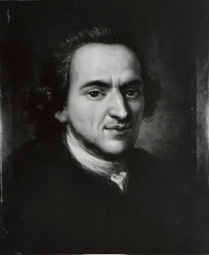
Painting by Christian Bernhard Rode.
The picture had been on display since 1768 in an exhibition established by J. W. L. Gleim in Halberstadt, was removed from there by the National Socialists in 1933, and has been missing ever since.
[Page 4] The young couple lived in Berlin in the following years, where their center of life would remain for a quarter century. It was a love match, in which external circumstances mattered little. In an article in "Die Welt" dated 18 June 2012, the reporter Uwe Bahnsen writes:
"When Moses Mendelssohn courted Fromet Gugenheim, his outward appearance did not exactly make him the type of a handsome man in his prime. His son Joseph (the couple had ten children, of whom six survived infancy) later portrayed him thus: 'He was of small stature, hunched in the shoulders, which formed a pronounced hump; he often stuttered when speaking. In contrast to this unfortunate physique, his head was very finely formed, and all his facial features announced a lofty spirit and a magnificent temperament.' It was probably above all the human richness that distinguished him, with which he won over Fromet Gugenheim, when he confessed his love to her in a rather unromantic setting, an uninspiring garden house."
The writer Bertold Auerbach (actually Moses Baruch Auerbacher, 1812-1882) -- as reported on a website of the Mendelssohn Society -- processed the events surrounding the beginning of their love story in anecdotal form. The already smitten Moses, Auerbach tells, had sensed that his hump frightened the young woman and wanted to take his leave from her. "Finally, when he had skillfully turned the conversation, she asked: 'Do you also believe that marriages are made in heaven?' Mendelssohn replied: 'Certainly, and something special happened to me. At the birth of a child, it is proclaimed in heaven: such-and-such shall have such-and-such. When I was born, my wife was also proclaimed to me, but it was added: she will, alas, have a hump, a terrible one. Dear God, I said then, a girl who is deformed easily becomes bitter and hard; a girl should be beautiful. Dear God, give me the hump, and let the girl be slender and well-formed.' At this, Fromet is said to have thrown her arms around his neck."
In June 1761, Moses Mendelssohn writes the following words about Fromet to his friend G. E. Lessing:
"Our correspondence has been interrupted long enough; I must now renew it. I would never have been able to keep silent so long had I not made a journey to Hamburg that entangled me in a thousand distractions. I visited the theater, I met scholars, and, what will surprise you no little: I have committed the folly of falling ... in love. ... The woman I intend to marry has no fortune, is neither beautiful nor learned, and yet I, lovesick fool, am so taken with her that I believe I can live happily with her."
On 29 July 1761, Moses Mendelssohn sends his bride the following words:
"Dearest Fromet! I have made a discovery in your father's letter that delights me not a little. The kind man assures me that his daughter Fromet is as beautiful as she is virtuous. What do you think? Can one believe an honest man on his word? The good Herr Abraham Gugenheim must surely know that philosophers also like to have something beautiful. But he may forgive me that. I know his Fromet better than he does. She is beautiful, but not as beautiful as she is virtuous, and not as beautiful as she is tender. I envy you, dearest Fromet! for the happy way in which you know how to express your gentle love."
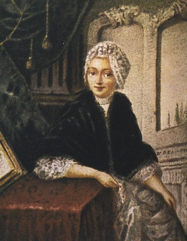
Fromet Gugenheim, the wife of Moses Mendelssohn
[Page 6] On the aforementioned website of the Mendelssohn Society, the following is further written about Fromet Mendelssohn under the heading "The Boss from Altona":
"As mother, head of household, and hostess, Fromet is the strong, clever personality behind the philosopher, who as factory owner and scholar attracts the most diverse business and conversation partners, students, and acquaintances, while overtaxing his own strength. She organizes the household in which enlightened tutors and relatives live with the Mendelssohns; she watches over the finances and is said to have served snacks -- almonds and raisins -- counted out to guests who were learning to exchange their opinions in this free space."
Moses Mendelssohn was interested throughout his life in many personal, scholarly, and business friendships and relationships. His published correspondence bears witness to this and points to a whole series of such contacts with Mecklenburg as well. Private and business trips took him to many places in the German lands, and in Mecklenburg particularly to Strelitz, the residence of the ducal family of Mecklenburg-Strelitz.
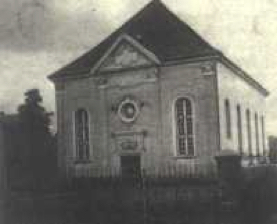
The synagogue consecrated in mid-1763 in Alt-Strelitz on Brandenburger Strasse (in a photograph from 1914)
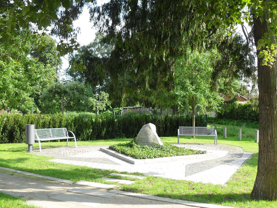
Near the synagogue in Alt-Strelitz, the Jewish cemetery was located at Alexanderplatz (present-day memorial at this site)
Here in Strelitz, two old acquaintances of Moses Mendelssohn had settled. When, where, and how these acquaintances and friendships arose, we cannot say precisely, but with great probability it was before the two merchants settled in Strelitz. They were Moses Lemelson and Nathan Meyer.
Among his friends, Nathan Meyer should certainly be mentioned first, whom Moses Mendelssohn in a letter dated 27 April 1784 described as "my very special and most dearly beloved friend, ducal court agent in Strelitz."[3] There are indications that Moses Mendelssohn had long been in a business relationship with Nathan Meyer, which was quite possible since Mendelssohn also ran his own silk trade. Nathan Meyer received recognition as a protected Jew [Page 8] on 30 July 1766.[4] In those years, the Duke of Mecklenburg-Strelitz sought to secure the economic strength of Alt-Strelitz, which had been declining since the relocation of the sovereign's seat to Neustrelitz from 1733 onwards, particularly by granting permission for suitable Jewish individuals and their families to settle. On 24 September 1775, Nathan Meyer was appointed chamber agent -- in effect, the house banker -- and his privileges were naturally extended to Neustrelitz as well. In 1792, he was granted special permission to purchase a property on Neustrelitz Schlossstrasse for 1,510 Reichstaler in gold, with the stipulation that the house be representatively expanded facing the street.
It is known that during the 1770s and 1780s, Moses Mendelssohn regularly sent his children to Strelitz for summer holidays; they and possibly their mother Fromet would then stay with the family of Nathan Meyer. Decades later, on 25 November 1832, Brendel Mendelssohn wrote to her brother Joseph that she remembered "that so peaceful, childlike time, when we in Alt-Strelitz ... were so often received in the summertime." This was surely always a welcome change for the children after the relatively strict education and formation system in the Mendelssohn family. Moses Mendelssohn taught his children largely himself. His biographer Kayserling writes, with reference to Lessing's "Nathan the Wise," the following words about Mendelssohn's educational style: "As mild and calm, as modest and composed as Nathan, so too spoke Mendelssohn, with deep meaning yet never demanding, so too flowed his speech. As Nathan taught his Recha, so Mendelssohn instructed his own daughter. He proceeded step by step in developing her religious ideas; he sought to direct her toward natural concepts and natural phenomena as soon as he noticed that enthusiasm was taking hold of her young mind." For his son Joseph (1770-1848), several of Joseph's friends, and his older daughters, he held regular private lectures, known as "Morning Hours" (Morgenstunden), which were later also published by Moses Mendelssohn.
As early as 6 September 1785, Moses Mendelssohn reports in a letter to a friend that he had promised his daughter Recha (or Rachel), born 1767, to Mendel, a son of Nathan Meyer. Recha appended a postscript to her father's letter: "We are going to Neu-Strelitz, a place [Page 9] that is quite pretty, though not at all to be compared with Berlin." She already knew Mendel Meyer from her childhood summers in Strelitz. In September 1785, her fiance was also visiting Mendelssohn and his family in Berlin. In the summer of 1786, shortly after her father's death,[5] Recha married Mendel Meyer in Strelitz, having just reached the age of 19. Some time later, she took in her mother Fromet, her grandmother Vogel Gugenheim, her sister Henriette, and her younger brothers into her Strelitz residence in the same year. Henriette moved to Berlin in 1793. In the same year, their grandmother Vogel passed away. The marriage of Recha and Mendel Meyer was not happy; it was disharmonious and ended in divorce in 1800. After the divorce, Recha and Fromet moved to Altona, where Recha opened a boarding school for young girls in 1802. After her mother Fromet also died in 1812, Recha joined her brother Abraham and moved with him to Berlin.[6]
Of interest are some remarks about Henriette Mendelssohn, who -- unmarried throughout her life -- worked as a governess, first in Berlin, then for many years in Paris, and finally again in Berlin, impressing those around her. Goethe, for example, who had met Henriette in Karlsbad, expressed himself very positively about her: "Yes, she is a loving girl; she is strong in every one of her feelings, and yet light in every expression; the former gives her great significance, the latter makes her pleasant; the former makes us admire her great originality, and the latter makes this originality lovable, makes it please us. ... She is, as far as I know her, at every moment [Page 10] equal to herself, always moved in her own way, and yet calm -- ... she is what I would call a beautiful soul." After the death of Henriette Mendelssohn on 9 November 1831, Goethe's friend Zelter wrote in a letter to him: "It is among the remarkable things when a Berlin Jewish girl, without personal advantages, having become the lady of one of the foremost Parisian houses of rank, shows not the slightest difference in language, manners, or economic conduct. In the ten years since she has been back in Berlin, seen by me so often and gladly, I have hardly heard a French, English, or Italian word from her mouth; rather, she spoke the clearest, most fluent German, with a cheerfulness in which I thought I recognized your beautiful soul."[7]
How often Moses Mendelssohn himself actually stayed in Strelitz with his friends and relatives cannot be determined. We know of only a few references from him personally in which a stay in Strelitz is mentioned. On 24 August 1778, Moses Mendelssohn writes a letter to his good friend Elkan Herz in Leipzig about a visit in the first half of August of that year. In it he says: "Dear friend! You still owe me an answer to my latest letter. Since then I have undertaken a pleasure trip to Strelitz to visit a good friend, where I stayed for about 14 days." The good friend was Nathan Meyer. In the same letter, he gives information about nearby Fuerstenberg, where he had stayed only about six hours: "I readily acknowledge that the said place appears, by all accounts, to be suitable for earning one's livelihood there." From the following year as well, there is a statement by Moses Mendelssohn about another summer stay in Strelitz. He writes on 29 June 1779 from Strelitz to his friend August von Hennings in Copenhagen: "I have traveled here for a few days to visit a friend. I have no business here, no books, no distractions. I can collect myself and think at leisure about the affairs of my heart, and you, my dearest! shall be the first with whom I wish to converse in this state. ... On the whole, my heart has little excitability toward anger, vexation, remorse, and such unpleasant affections. I am only still sensitive to love and friendship, and even in this to such a moderate degree that my friends very often accuse me of [Page 11] moodiness. But I cannot give myself feelings that I do not have, and I do not wish to feign them, however much the affectation of fashion seems to demand it."
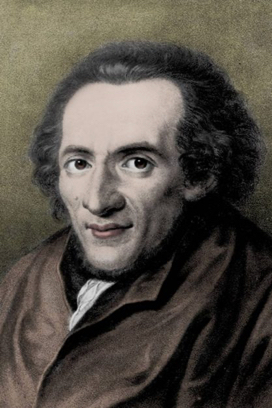
Mendelssohn and His Assessment of the "Early Burial" of Jews
One can surely assume that Moses Mendelssohn was generally known to many Jewish community members in Mecklenburg as a philosopher and religious scholar, and was esteemed by both Jews and non-Jews alike. This is evidenced, among other things, by an incident from the year 1772, when the board of the Jewish community in the residential city of Schwerin had turned to Moses Mendelssohn in Berlin with a request for comment and support. What had happened? In the early 1770s, a discussion had arisen -- triggered above all by Professor Oluf Gerhard Tychsen [Page 12] (see the following section on Tychsen in this essay) -- about whether Jews should continue to be permitted to bury their deceased fellow believers, as a rule, on the very day of death. It was suggested that this practice might result in apparently dead (but actually still living) persons being improperly buried. Although even a legal opinion by the ducal government from February 1772 recognized the Jews' right to prompt burial of the deceased, Duke Friedrich of Mecklenburg-Schwerin sided with the expressed concerns and issued a decree on 20 April 1772 obliging Jews to leave their dead unburied for at least three days. The text of the rescript is given below:
"Rescript to all protected Jews in the Ducal Mecklenburg-Schwerin Lands, concerning the burial of their dead.
We Friedrich, by the Grace of God, Duke of Mecklenburg, Prince of Wenden, Schwerin and Ratzeburg, also Count of Schwerin, Lord of the Lands of Rostock and Stargard, etc.
We hereby inform you, all protected Jews in Our ducal principalities and lands, that the custom observed by most among you of not leaving the dead overnight in the house of death but rather burying them on the very day of their passing may very often result in a person lying merely in a deep faint or in insensibility caused by other accidents being regarded as actually dead and thus, in a manner, buried alive. Since such hasty burial does not belong to your articles of faith, you are, in accordance with Our highest intention directed toward your own welfare and your own safety of life, hereby one and all commanded to refrain from such early burial henceforth and from now on to leave your dead unburied for at least three days. By which you are to govern yourselves."
This "question of early burial" thereby became an existential problem of faith for many Jews. Kayserling writes of it: "An outcry arose among the Jews of Mecklenburg, as if banishment or expulsion had been threatened, as if the sovereign had wanted to force them to abandon the religion of their fathers or to transgress a Mosaic law. Parents should hand over their children, children their parents, to the earth only when every concern of apparent death had passed; this [Page 13] they called, in heartfelt piety, 'walking in the ways of the nations, turning them away from the faith of the fathers.'"
As early as 15 May 1772, the Jewish community therefore petitioned the Duke to withdraw his decree. At the same time, the community turned to Moses Mendelssohn in Berlin for support. The letter stated, among other things:
"Therefore the call goes out to you, that by virtue of your great knowledge, which contains much and lofty wisdom inaccessible to us: perhaps you could manage to dissuade the prince from his intention. The rescript is based on the claim that there is no prescription for it in the Law of Moses. But the words of Moses were explained according to tradition, which stands unshakably firm for us from generation to generation. Who, however, could remain indifferent in the face of such tyranny against the matter? So may you give an answer that could serve as a fence against our adversaries who dare to rise up against our famous and exalted men. This will redound to your great merit as a gracious deed in the interest of broken hearts. Through this act you will partake of all the good that is stored up for the God-fearing."
Moses Mendelssohn responds quickly. Still in May 1772, he answers his fellow believers in Schwerin:
"To the honorable community of Schwerin!
I have duly received your kind letter from last month. I see from it that your sovereign has commanded you to keep the dead for three days before you have them buried. You, gentlemen! seem to be as troubled and aggrieved about this as if the sovereign had wanted to force you to abandon the religion of our fathers, or to transgress a Mosaic law, or at least a precautionary rule of the rabbis.
I freely confess my ignorance that I do not see this, and cannot comprehend the reasons for the great measures you wish to take against it. Although I know that your rabbi is a legal scholar and has dealt sufficiently with legal scholars to decide this matter himself, I will not refrain from communicating my opinion to you. If I err, I shall gladly accept correction. In my [Page 14] judgment, therefore, compliance with this sovereign command involves not the slightest transgression of the law, as you believe you find."
After providing more detailed reasoning for his view, Mendelssohn remarks:
"I therefore send you a draft of a petition which, in my opinion, you should submit to your sovereign. In all probability he will be satisfied with this proposal; and every mortal will thereby be gathered in peace to his fathers."
The "draft" intended for the Duke contains a concrete presentation of Mendelssohn's view that there is no real justification for insisting on "early burial" without exception. He therefore recommends that the Schwerin community inform the Duke:
"In order to free our conscience in all cases and to be fully assured that, on the one hand, no person is buried in whom there is still some life, and that, on the other hand, no corpse is kept in the house longer than necessary, we shall in future no longer rely on our own judgment, but on the statement of a medical expert, and shall not bury the dead until an experienced physician has examined the body and judges according to the rules of his art that there is no longer any doubt about death. As this meets Your Ducal Highness's highest intention and paternal care in the best and most certain way, while at the same time not infringing upon our religious customs, we most humbly beg Your Ducal Highness to deign to limit Your gracious decree of 30 April of this year to the effect that from now on no corpse shall be buried before it has been examined by an approved physician and the certainty of death has been confirmed by him. We trust in gracious hearing and remain Your Ducal Highness's etc."
The Duke of Schwerin took up Mendelssohn's views, and his position brought about the partial modification of the first ducal decree.
For our purpose of identifying the connections between Moses Mendelssohn and Mecklenburg, this incident of 1772 is of particular significance. It is a fact that the discussion about early burial, which began in the early 1770s and lasted until about the end of the 1790s, had its starting point in Mecklenburg. The discussion, which extended over more than 20 years, reached a further climax only in the [Page 15] 1790s. Once again, the initiative for a new regulation of Jewish burials came from Mecklenburg, this time from the Duchy of Mecklenburg-Strelitz. After some disputes on the matter within his own territory, Duke Adolf Friedrich took up the problem in 1793 in a letter to the Strelitz Jewry, stating that it was now time to end the tradition of early burial in Strelitz as well. The Strelitz Jewish community, however, was only willing to bow to the ducal demand if certain preconditions were met. It rejected the attempts at abolishing early burial in Strelitz made by the Jewish candidate Michaelis, who was the tutor of the children of chamber agent Nathan Meyer. Silberstein later summarized the position of the elders and wardens of the community thus: "They lodge a protest against the new efforts and ask the Duke to leave them in their old customs ... The newer writers are making an incursion into the old customs, wanting to destroy Jewish law; who knows what may follow, whether perhaps, following the precedent of the French Revolution, the Jewish religion itself is to be buried. In any case, Strelitz shall not be the one to begin. Only if the three cities -- Berlin, Hamburg, and Schwerin -- lead the way with this arrangement will they comply." Duke Adolf Friedrich responded in two directions. First, he asked the governments of the territories in question, especially the Prussian government in Berlin, to join in abolishing early burial by decree. The Schwerin government had already taken corresponding measures in 1772; of Hamburg, we do not know the development. Second, the Duke accommodated the Strelitz Jews to some extent by inserting a compromise provision in his decree of 13 February 1794: "All protected Jews in Our land are hereby one and all commanded henceforth not to bury their dead earlier than after the expiration of three days following death, thus to leave a corpse unburied for at least three full days, unless an approved physician, after examination, has given his written consent to earlier burial." He thus adopted the Schwerin regulation that had been in existence for more than 20 years. The response from Berlin to the Strelitz Duke's request came very late. The Berlin Jews insisted on the traditional practice, so that the competent Prussian government councillors as late as February 1795 still recommended: "... under such circumstances, it appears to us best not to compel the Jews here just yet, but rather to await a more widespread enlightenment in this [Page 16] regard." Thus it came about that in Prussia, a new regulation was not enacted until 25 September 1798 by royal decree of Friedrich Wilhelm III. Silberstein notes: "The question of whether someone is dead or not, it states therein, is not a matter of religion but of physics; it is therefore only for the state police ... to issue rules about the signs of death and accordingly to determine the time of burial and the precautionary measures to be observed beforehand."
It is established that the discussion about early burial, conducted in the German lands for about 30 years, originated in Mecklenburg. Silberstein summarized his assessment with the words: "In any case, Mendelssohn retains the great merit of having been the first to point out the erroneous belief that early burial had to take place for religious reasons. Everywhere in the negotiations, his views were invoked to abolish this malpractice." We can assume that the Schwerin statement on early burial, whose significance to the present day is generally underestimated, was an important factor in Mendelssohn's effort to promote the emancipation of Jews and to support their integration into the social conditions of the time. With his recommendation, Mendelssohn effectively implemented a thesis that he later, in 1783, expressed in his work "Jerusalem, or on Religious Power and Judaism" -- namely, that it is permissible, with all due respect for religious laws, to reflect upon the law in order to determine whether it might not be adapted to circumstances in new times and other places, and that custom and law must be distinguished. The author Bernhard expressed this similarly in a more recent publication:
"The point of his proposal was to be able to continue the burial ritual by bringing it into harmony with a changing world. Jews could take up the demands brought to them from outside without having to abandon themselves. At the same time, the idea of involving a quasi-official physician satisfied the claim of the early modern state."[8]
Moses Mendelssohn and the Orientalist O. G. Tychsen in Buetzow
[Page 17] Moses Mendelssohn was in extended intellectual exchange with a scholar from Mecklenburg, Oluf Gerhard Tychsen (1734-1815), who came from Denmark, had studied at the University of Halle, and from 1763 to 1789 served as Professor of Oriental Languages at the Friedrich University in Buetzow, Mecklenburg-Schwerin, founded by Duke Friedrich of Mecklenburg-Schwerin in 1760.[9] Tychsen's field of expertise focused particularly on Semitic languages, including Hebrew and Yiddish; he also considered himself an expert on the Talmud. As a Lutheran Pietist, he was, on the one hand, an active but unsuccessful missionary for the conversion of Jews to Christianity, while on the other hand he saw himself as a mediator between Jews and Christians. Moses Mendelssohn sent him drafts of various works of his own, including translations for his edition of the Five Books of Moses.
Tychsen was by no means among the foremost Orientalists at German universities, but despite some personal reserve, he liked to present himself as an outstanding expert in the field. Such an attitude is expressed in various epistolary remarks by Tychsen, as when he notes "that Mendelssohn has rendered much quite well in German ... but has also sometimes neglected good German expression," or when he reports that Jews had said to him dismissively about the Mendelssohn translations: "What, that chammer (donkey) doesn't understand taitsch (German)!" Mendelssohn, [Page 18] for his part, was disappointed by the gaps in Professor Tychsen's knowledge; he wrote, among other things, on 8 February 1874 to an acquaintance in Leipzig: "What ... has greatly surprised me is the very limited knowledge of this scholar in Rabbinic matters: Of all the passages he cites from the Talmud, not a single one is correctly translated; and most reveal that he, who talks so much of rabbinic learning, is entirely ignorant of the Talmud."[10] And Tychsen, after being accused by a Berlin Jew named Lohnstein of a "contemptuous encounter toward Mendelssohn" in 1788, remarked in a mitigated but still dismissive manner: "Against Mendelssohn I have said nothing improper. He was one who, notwithstanding his other recognized merits, could have a say. His chief study was philosophy, through which he acquired a famous name. I would not have mentioned him at all had Herr L(ohnstein) not pressed me so closely."
A particularly intense dispute developed around a series of writings that Tychsen had published in Buetzow between 1764 and 1769 in six parts: "Buetzowische Nebenstunden, devoted to various matters pertaining to Oriental learning." In Volume XI of the "Allgemeine Deutsche Bibliothek," Part 2, p. 208, a brief review of the first five issues of the "Nebenstunden" appeared, signed "B*" and interpreted by Tychsen and others as a review from the pen of Moses Mendelssohn. It reads:
"A wretched scrawl! Whoever has a desire to read reports on the history of the Jews in Mecklenburg, on new Jewish writings, on coins ... and other such things -- all of it mixed with much useless chatter, in an unbearable and often vulgar style, especially also with a generous measure of authorial immodesty -- may read the book. We gladly subscribe to the good advice that someone gave him (he writes himself, Part 2, Preface), 'that to save his salary, barely sufficient for his meager livelihood, he would rather not have anything printed at all.' But he will not follow it."
The author Leopold Donath later writes in his "History of the Jews in Mecklenburg" of 1874 about Tychsen:
"In his notorious 'Buetzow'sche Nebenstunden' he portrays himself as a [Page 19] second Eisenmenger.[11] But there are also passages therein which, through shamelessness escalating to outright obscenities, are a true disgrace to German literature; and the tastelessness of the presentation does not remotely suggest the age of Lessing, Herder, Mendelssohn, Goethe, Schiller, etc."
It is worth noting that Tychsen left behind an extensive collection of letters from his correspondence with Jews, which served by no means only for his own information and education. In many letters to the Grand Duke, he passed on his knowledge, even when some information was confidential. He was evidently concerned with maintaining the Grand Duke's goodwill through such informant activity. That he spoke to the sovereign's liking is also shown by an example from 1812, when Tychsen presented the Grand Duke with a positive expert opinion on the planned emancipation of Jews in Mecklenburg-Schwerin and later wrote to an acquaintance that the Duke had demanded such a positive opinion. In a more recent study, it is noted that a biographer of Tychsen had already connected this opinion "with 'certain considerations' that one believed had to be observed"; he thus classified the document as a "favor opinion for the Duke." The current author added: "This assessment is not entirely to be dismissed."[12]
[Page 20] In a contribution by U. Heinsohn and J. Jennrich from 2015, it states in the same context:
"Jews could never blindly rely on Tychsen's goodwill. Initially, he sought to attract readers through sensational material in his writings, and he therefore exposed many a Jewish peculiarity to uncomprehending or even malicious non-Jewish ridicule."
A well-versed expert on the letter collection writes about the addressee Tychsen, "who, depending on his role and interest as universal scholar, university professor, collector, or Jewish missionary, cultivated his relationships with Jews. It appears, however, that among all of Tychsen's self-positionings, the missionizing of Jews held absolute priority."[13]
The actual motives for Moses Mendelssohn's reaching out to Tychsen in Buetzow cannot be specifically named. There were actually few commonalities in the scholarly and religious-theoretical ambitions of the two men. Mendelssohn certainly sought inspiration for his own work from a non-Jewish Orientalist as well. It can also be assumed that Mendelssohn wanted to gain more attention for himself among the Jews and non-Jews of Mecklenburg through Tychsen. The relationship between Mendelssohn and Tychsen remained highly ambivalent: they respected each other to a certain degree, but criticized each other sharply.
Family Developments after the Death of Moses Mendelssohn
After nearly 15 years that had severely burdened him through a serious nervous illness and the resulting recurring incapacity for work, Moses Mendelssohn died on 4 January 1786 in Berlin. The great Jewish community of the city, together with many Christian acquaintances and friends, accompanied him on his final journey to his burial in the Jewish cemetery. In the edition of "Letters from and to Mendelssohn" by Ludwig Geiger, an appended section on the remarks of Mendelssohn's friends states, among other things: "It was understandable that Mendelssohn's death made a great impression on all friends of [Page 21] German literature. The sympathetic figure of the philosopher and enlightener had enjoyed universal respect; people looked upon him with a certain reverence which even his opponents did not deny him."
Fromet Mendelssohn, his widow, "who had kept her husband's back free throughout his life," as a SPIEGEL article of 24 April 2013 put it, now had to reconsider her future. She and her children received common right of residence only on 4 January 1787, after years of effort. Fromet entrusted the future publication of all printed and unprinted works to some friends of her husband, as she announced on 18 May 1786 in a notice in the "Berliner Privat-Zeitung." She decided to remain in Berlin and purchased in the same year the house at Spandauer Strasse 68 for 5,000 Taler. She had already lived here with her husband and children, as well as with her stepmother Vogel Gugenheim, the second wife of her father Abraham Gugenheim who died in 1766, for 20 years as a tenant. Although she had inherited a small fortune, she sought possible benefits in the interest of her children's future situation. On 17 June 1787, she turned to the Prussian King and requested a "General Privilege" for her children and their descendants with all the rights of Christian merchants. She now actually achieved what Moses Mendelssohn had been unable to achieve under Friedrich II. On 21 March 1788, King Friedrich Wilhelm II granted her request, "of his own highest accord, on account of the well-known merits of her husband." Fromet Mendelssohn, however, soon decided to leave Berlin in order to no longer be exposed to big-city life. She sold the house on Spandauer Strasse and wanted to move to her relatives in Strelitz. Her daughter Dorothea wrote on 15 September 1788 to her sister in Strelitz: "Mama truly lives too restlessly here now; her frail body would not be able to endure it much longer; she would also only become more and more discontented; there, however, she will be able to live quite peacefully." Shortly thereafter, on 1 November 1788, Fromet Mendelssohn "most humbly" requested the Duke's permission to take up residence in Neustrelitz and to be allowed to purchase a house in the city. The Duke had his ministry prepare an expert opinion as the basis for his decision, which was completed on 13 November 1788. The ducal government also assumed that the petitioner must be able to live from her own means and to purchase a potential house. The Duke's Privy Council then issued a privilege on 23 December 1788 with reference to her famous husband and his previous connections to Strelitz, stating: "Since we have most graciously permitted the widow Mendelssohn from Berlin, upon her most humble [Page 22] petition, to settle here in Neu-Strelitz and also to purchase a house, she shall not be entitled to sell the latter to any Jew without Our sovereign permission, and in case she engages in trade here, she shall pay a sum to be determined hereafter, but shall otherwise be subject to the established trade laws ..."
Fromet Mendelssohn, however, did not initially seek to purchase a house but lived for some years in the house of her second-eldest daughter Recha and her husband Mendel Meyer, the son of chamber agent Nathan Meyer, in Strelitz, as we have already mentioned above. Recha had married her husband at her father's wish still in 1786, but after the death of Moses Mendelssohn. Her younger siblings also lived with her temporarily. She also took in Fromet Mendelssohn's stepmother, Vogel Gugenheim, called "Voegelchen" (little bird), who had been cared for and looked after by Fromet after the death of Abraham Gugenheim in 1776. Vogel Gugenheim died on 25 May 1793 in Neustrelitz; she found her final resting place in the Jewish cemetery of Altstrelitz.
The marriage of Recha and Mendel Meyer had increasingly encountered problems; it was disharmonious. This deteriorating situation in her daughter Recha's household surely provided the impetus for Fromet Mendelssohn to then strive after all to acquire her own house. On 5 December 1798, she notified the ducal government that, on the basis of her privilege of 1788, she had purchased the house of chamber agent Nathan Meyer located on Schlossstrasse, including the special right belonging to the house to use a rear entrance. As already described, Nathan Meyer was an old friend of her husband Moses Mendelssohn, who had acquired this house at an auction at the Strelitz town court in October 1792. Nathan Meyer, however, had already left Strelitz in the first half of 1798 and established himself independently in Altona. Since the Strelitz Duke had no interest in an absentee chamber agent, he demanded on 21 August 1798 the return of the patent issued to Nathan Meyer on 24 September 1775, which the latter also completed in the same month. Nathan Meyer intended, in his own words, with his move to Altona "like a thousand others ... to profit from the current commercial conjunctures." He naturally had an interest in selling his Strelitz property after his departure. The ducal government, however, rejected the purchase of the house by Fromet Mendelssohn. It justified this by stating that Schlossstrasse was excluded from [Page 23] settlement by Jewish citizens, that the general concession of Fromet Mendelssohn did not extend to a house purchase on this street, and that Nathan Meyer had possessed only a special dispensation "only out of special grace and in consideration that he was at the time an actual ducal servant bearing a title." The Duke, who had already signed this rejection, withdrew his signature on 21 February 1799, however, and permitted Fromet to take over the house "by purchase and ownership." This permission, linked to various conditions, is an interesting example of the manner in which Jewish residents were still denied the rights of a citizen at the end of the 18th century. Silberstein lists the conditions contained in this document, according to which Fromet Mendelssohn had to accept:
"1. that she not resell the house to any Jew,
2. after her death, her family may still occupy the house for one year, but it must then be resold to a Christian,
3. that she not take in any foreign or outside Jews as tenants, or harbor foreign or outside Jews without police concession even for a single night,
4. that she not establish a Jewish school or synagogue therein without our highest permission, and finally
5. as goes without saying, that she bear all burdens on the house and its appurtenances that are either already now imposed upon houses and their appurtenances in the city, or will be imposed or apportioned upon them in the future. By which she is to govern herself."
After the divorce of her daughter Recha from Mendel Meyer was finalized in 1800, Fromet and her stepmother joined her daughter, who went to Altona and opened a boarding school for young girls there. In this connection, Fromet also sold the recently purchased house to the Strelitz chamber assessor v. Bassewitz.
Fromet Mendelssohn, nee Gugenheim, died on 5 March 1812 at her daughter Recha's home. She was buried three days later in the Jewish cemetery in Altona on Koenigsstrasse. Recha then left Altona and moved to her youngest brother Abraham and his family in Berlin.
[Page 24] Let us return once more to the starting point. Moses Mendelssohn was always striving throughout his life to think and act humanely. Friedlaender wrote of him: "His life taught. His spotless character needs no concealment of weaknesses, his virtues no embellishment, his lovability no rhetorical aid. But this does not deny that he belonged to our species, that he was a human being and not an angel." In the autograph books of many of his students, Mendelssohn wrote his own life's maxim:
"The destiny of man: To seek truth, to love beauty, to desire the good, to do the best."
Notes and Sources
- [1] Wir stützen uns hier besonders auf folgende Veröffentlichungen:
Silberstein, Siegfried: Moses Mendelssohns Witwe in Neustrelitz. – In: Zeitschrift für die Geschichte der Juden in Deutschland. – Jg. 3/1931, H. 2-3, S. 123-129.
Derselbe: Mendelssohn und Mecklenburg. – In: Ebenda, Jg. 1/1929/30, , H. 3, S. 233 ff. und H. 4, S. 275 ff. - [2] Friedländer, David: Über Mendelssohn, seinen Charakter, seinen Wirkungskreis und seine Verdienst um die Israeliten. – Ein Fragment. – In: Derselbe: Moses Mendelssohn. Fragmente von ihm und über ihn. – Berlin, 1819. – S. 16.
- [3] Im gleichen Brief erwähnt Moses Mendelssohn „Lemle’s Sohn“ als seinen „alten Bekannten und Freund“. Dabei handelte es sich um Carl Moses Lemelson (auch bekannt unter Lemmelson bzw. Lemelsohn), geboren 1747. Er stammte aus Schlesien. Wie der etwa 18 Jahre jüngere C. M. Lemelson mit Mendelssohn bekannt wurde und welche Gründe ihn schließlich in das Strelitzer Herzogtum führten, wissen wir nicht. Wir können nur sagen, dass er 1783 in Strelitz Schutzjude wurde, ein offizielles Niederlassungs- und Handlungsrecht erwarb und am 21.04.1784 die Genehmigung für den Betrieb einer „Sozietätshandlung“ (die er zusammen mit dem Mendel Meyer, dem Sohn von Nathan Meyer, führte) mit der Festlegung erhielt, „sowohl fremde Waren und Güter anhero kommen zu lassen als auch hiesige Produkte auswärts zu versenden“. Das Geschäft lief gut, C. M. Lemelson wurde eine anerkannte Strelitzer Persönlichkeit. Die Strelitzer jüdische Gemeinde wählte ihn 1790 schließlich zum Vorsteher und Ältesten. Anfang des 19. Jahrhunderts erwirbt C. M. Lemelson eine Papiermühle In Wanzka bei Strelitz, wo er schließlich auch seinen Wohnsitz bis zu seinem Tode im Jahre 1829 nimmt.
- [4] Nathan Meyer ist der Schwiegersohn von Moses Mendel, der Strelitzer Schutzjude seit 20.09.1758 war, 1765 Judenältester in Strelitz wurde, in den achtziger Jahren in wirtschaftliche Schwierigkeiten geriet, und schließlich seinen Pass zurückgab.
- [5] In einigen Veröffentlichungen wird davon ausgegangen, dass die Heirat noch vor dem Tode von Moses Mendelssohn vonstattengegangen sei. Dies ist aber unwahrscheinlich. SILBERSTEIN weist mit Recht daraufhin, dass Mendel Meyer einen Schutzbrief für Strelitz erst am 11.05.1786 erhält, ohne den die Heirat und der Wohnsitz für seine Familie wohl kaum möglich gewesen wäre.
- [6] Offensichtlich hatte Moses Mendelssohn nicht immer eine glückliche Hand bei der Auswahl der Ehemänner für seine Töchter. Auch seine älteste Tochter Brendel (1763-1839) bestimmte er als Ehefrau für Simon Veit, den Sohn des Kaufmanns und Bankiers Veit, einer seiner Freunde in Berlin. Bereits mit 14 Jahren wird sie 1778 mit dem zehn Jahre älteren Simon Veit verlobt, den sie mit 18 Jahren 1783 in Berlin heiratet. Ihre Ehe nimmt auch einen negativen Verlauf. 1797 lernt Brendel Friedrich Schlegel kennen und wird seine Geliebte. Sie trennt sich quasi von ihrem Mann, den sie wenig Später auch verlässt und zu Friedrich Schlegel zieht. Ihre Schwester Henriette schreibt im November 1798 an A. W. Schlegel: „Die Veit hat schon gestern ihr Haus verlassen und den letzten großen Schritt zu ihrem Glück getan. Sie sieht mit Heiterkeit über alles was sie jetzt drückt hinweg, einer schönen Zukunft entgegen. Jeder der sie liebt freut sich mit ihr und teilt ihre Hoffnungen.“ 1799 wird ihre Ehe mit Simon Veit durch ein Rabbinatsgericht geschieden. Sie tritt zum Protestantismus über und heiratet 1804 Friedrich Schlegel. 1808 konvertiert sie ein zweites Mal, gemeinsam mit ihrem Ehemann, beide treten zum Katholizismus über. Sie selbst nimmt den Namen „Dorothea Schlegel“ an und wird eine damals durchaus bekannte Schriftstellerin. Ihr erster Mann Simon Veit bleibt trotz des Zerwürfnisses mit Brendel Berater und Beistand von Fromet Mendelssohn, seiner Schwiegermutter.
- [7] Beide Zitate siehe bei Peter Seibert: „Der literarische Salon. Literatur und Geselligkeit zwischen Aufklärung und Vormärz. – 1993, S. 429, Fn. 11.
- [8] Bernhardt, H.-M.: Bewegung und Beharrung. Studien zur Emanzipationsgeschichte der Juden im Großherzogtum Mecklenburg-Schwerin 1813-1869 (= Schriftenreihe der Gesellschaft zur Erforschung der Juden e. V.; Abt. A, Bd. 7), Hannover 1998, S. 59
- [9] „In unsern Tagen, wo auch hinsichtlich der Universitäten eine gewisse Konzentration sich vollzogen hat, möchte man den Plan, in einem kaum 160 000 Seelen zählenden Staat, in einer kleinen kaum über die Grenzen Mecklenburgs hinaus bekannten Landstadt eine Universität zu gründen, sonderbar finden und auf den Gedanken kommen, daß bei der Wahl dieses nur 4 Meilen von Rostock entfernten Orts die Schikane gewaltet habe; oder aber, wenn man die Geschichte Bützows berücksichtigt, denken, daß diese Stadt gewählt sei in der Erinnerung, daß hier vor langen Zeiten die Bischöfe residiert hatten, deren durch die Reformation frei-gewordene Rechte an der Rostocker Universität, zwar nicht ohne Widerspruch Rostocks, aus die Herzoge übergegangen waren. Aber Keins von beiden trifft zu; sondern als der Herzog den Plan gefaßt hatte, in der Nachahmung Halles mit der Universität ein Pädagogium und Waisenhaus zu gründen, bewog ihn nur die Rücksicht darauf, daß das große, leerstehende Schloß in Bützow ausreichend zur Aufnahme aller drei Institute sei, gegen das anderweitig vorgeschlagene Güstrow für Bützow sich zu entscheiden. Die Stadt Bützow zählte damals wohl kaum viel über 1000 Einwohner; ein großer Theil der Stadt lag noch von der großen Feuersbrunst von 1716 her wüst, die Bürger waren verarmt, das Handwerk nahrungslos. Ein anderer Mann als Döderlein, den der Herzog beauftragt hatte mit der Stadt zu verhandeln, hätte sofort erkannt, daß kein ungeeigneterer Ort für eine Universität sich finden ließ“. (Aus: Hölscher, Uvo: Urkundliche Geschichte der Friedrichs-Universität zu Bützow. In: Jahrbücher des Vereins für Mecklenburgisches Geschichte und Altertumskunde. – Bd. 50, 1885, S. 25 f.) - Tychsen, der sich selbst gern in den Mittelpunkt rückte, verstieg sich 1775 im Rahmen theologisch-philosophischer Streitigkeiten mit auswärtigen Gelehrten jedoch zu der Fest-stellung: „Wie Wittenberg, so hat Gott Bützow begnadet, daß aus dem Dunkel dieses Orts ein Licht aufgehen soll, den Freunden der reinen Lehre zum Ärgerniß zu gereichen.“ (Ebenda, S. 95).
- [10] Der Talmud ist eines der wichtigsten Lehr- und Theoriebücher der Juden, das zwar keine Gesetzestexte, aber Regeln und andere Interpretationen von den alten mündlichen Überlieferungen enthält.
- [11] „EISENMENGER der Zweite“: Diese Formulierung geht auf eine Person zurück, die 1700 mit einer zwei-bändigen Schrift das Judentum verleumdete. Johann Andreas Eisenmenger (1654-1704) war in seinen letzten Lebensjahren ab 1700 Professor an der Universität Heidelberg. Seine Veröffentlichung ist eine mit Fälschungen und Erfindungen gespickte Schrift, mit der er im Laufe der Zeit zum Wegbereiter des modernen Antisemitismus in Deutschland und darüber hinaus wurde. Der Titel dieser Schrift von Eisenmenger zu Beginn des 18. Jahrhunderts lautete: „Entdecktes Judenthum oder Gründlicher und wahrhaffter Bericht, welcher gestalt die verstockten Juden die hochheilige Drey-Einigkeit, Gott Vater, Sohn und Heil. Geist erschrecklicher Weise lästern und verunehren, die Heil. Mutter Christi verschmähen, das Neue Testament, die Evangelisten und Aposteln, die Christliche Religion spöttisch durchziehen, und die gantze Christenheit auf das äusserste verachten und ver-fluchen: dabei noch viel andere, bißhero unter den Christen entweder gar nicht oder nur zum Theil bekannt gewesene Dinge ...; alles aus ihren eigenen und zwar sehr vielen mit grosser Mühe und unverdrossenem Fleiß durchlesenen Büchern mit Ausziehung der hebräischen Worte und derer treuen Ubersetzung in die Teutsche Sprach kräfftiglich erwiesen und in zweyen Theilen verfasset, deren jeder seine behörige, allemal von einer gewissen Materie ausführlich handelnde Capitel enthält; allen Christen zur treuhertzigen Nachricht verfertiget und mit vollkommenen Registern versehen.“ Der jüdische Aufklärer der Mendelssohn nachfolgenden Genera-tion Saul Ascher hat bereits 1794 in einer Schrift J. G. Fichte wegen dessen Antisemitismus als „Eisenmenger der Zweite“ gekennzeichnet.
- [12] Siehe Bernhardt, H.-M.: Bewegung und Beharrung. – Studien zur Emanzipationsgeschichte der Juden im Groß-herzogstum Mecklenburg-Schwerin 1813.1869. – Hannover 1998, S. 80, Anm. 81.
- [13] Maksymiach, M. A.: Korrespondenz – Macht – Verflechtung. – Oluf Gerhard Tychsen und seine Sammlung von jiddischen und hebräischen Privatbriefen. – In: Jüdische kulturelle und religiöse Einflüsse auf die Stadt Rostock und ihre Universität. Hrsg. von G. Boeck und H.-U. Lammel. (Rostocker Studien zur Universitätsgeschichte, Bd. 28, 2. Aufl. Norderstedt, 2016.